Home
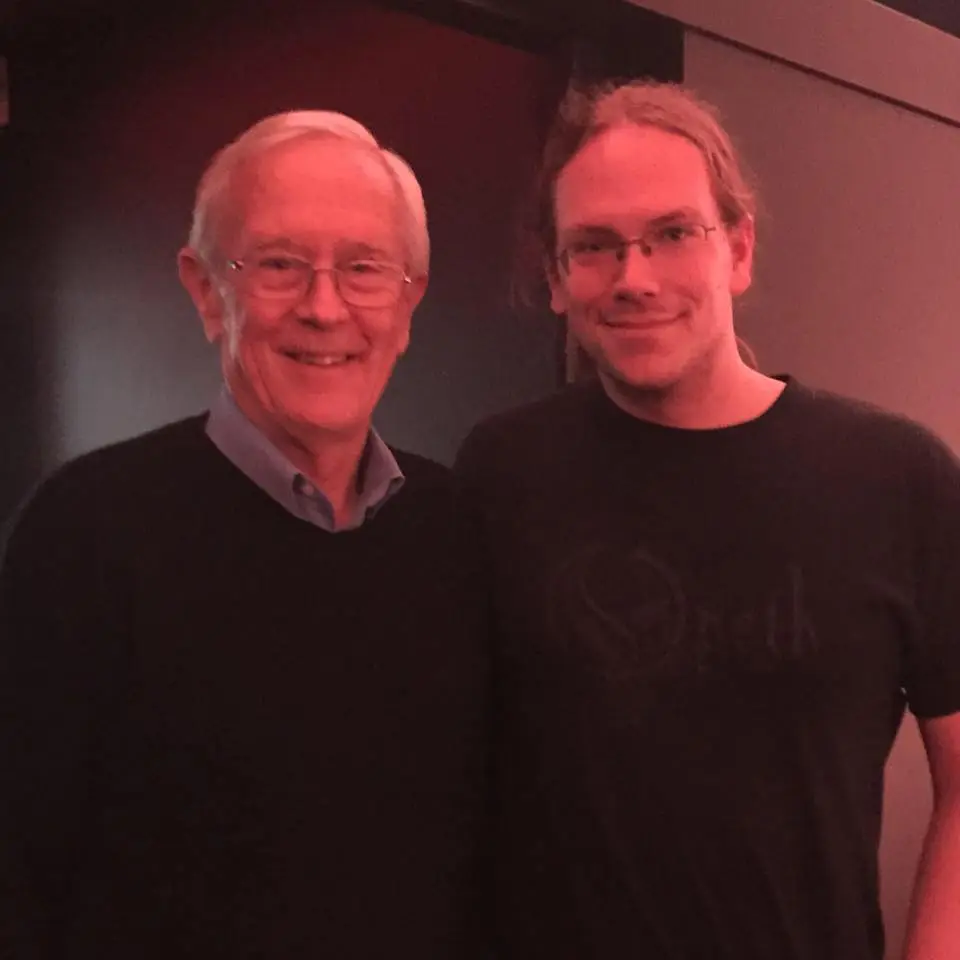
Hello and welcome to my personal homepage. I am currently an Assistant Professor for Immersive Visualization at Linköping University in Sweden and a Visiting Researcher at the American Museum of Natural History in New York. Prior to this in 2019-2020, I was a Post-Doctoral Research Fellow at the University of Utah’s Scientific Computing and Imaging Institute and from 2017-2018, I was a Moore-Sloan Data Science Fellow in the Center for Data Science at New York University after finishing my PhD at Linköping University. Since 2013, I am also the Development Lead for the OpenSpace project. This page contains a collection of my various private and professional projects, academical achievements, musings about the development of open-source software, various miscellenous items, as well as a curriculum vitæ. The picture shows me together with Charlie Duke after flying him back to his Moon landing location from Apollo 16.
In my research during my PhD studies and beyond, I am studying and using Visualization techniques to generate applications that can make difficult data, for example CT/MRI scans or astronomical datasets, easier to understand for a specific target audience, such as domain experts or the general public. Previous projects covered areas from biomedical simulations, deep-brain stimulation visualizations, urban search and rescue applications, topological analyses used for segmentation of fishes, as well as various astronomical and astrophysical phenomena.
OpenSpace is an open-source, collaborative project that aims at visualizing the entire cosmos. The project is a collaboration between Linköping University in Sweden, the American Museum of Natural History in New York, the Community Coordinated Modeling Center at NASA’s Goddard Space Flight Center, New York University, and the University of Utah’s Scientific Computing and Imaging Institute. The software is used for interactive visualization of astronomical and astrophysical phenomena and has been used in a variety of events. On July 15th, 2015 OpenSpace was used to visualize New Horizon’s flyby at Pluto in an event hosted by the American Museum of Natural History called Breakfast at Pluto. Other projects included visualizations of ESA’s Rosetta spacecraft, as well as planetary renderings on Earth and Mars. Another worthy live presentation in the Hayden Planetarium provided information about the Sun-Earth connection and the effect of Space Weather on it. See the OpenSpace YouTube channel for more examples.